
Learn how betting odds work, how to read fractional, decimal and American formats, and calculate payouts. Start understanding odds today.
Betting Odds Explained: A Complete Guide for Bettors

Betting odds represent the numerical expression of an outcome’s likelihood and determine how much a winning bet pays out. Bookmakers display them in different formats, but the underlying purpose stays the same across every sport and market.
Fractional, decimal, and moneyline are the three main odds formats, and each one presents the same probability in a different numerical style. Fractional odds tend to be favored in the UK, decimal odds are widely used across Europe and other international markets, and moneyline odds are most commonly associated with US sportsbooks.
Converting between fractional, decimal, and moneyline odds requires a simple mathematical formula for each format. Once converted, bettors can compare prices across different bookmakers using a single consistent reference point.
Implied probability is calculated by dividing 1 by the decimal odds, then multiplying the result by 100 to get a percentage. Payouts follow directly from the odds used, showing how much a stake returns if the bet wins.
Bookmakers set odds by combining statistical models, market information, and a built-in margin commonly called the overround or vig. This margin gives the bookmaker a theoretical long-term pricing advantage, but it does not guarantee a profit on every individual market or outcome.
Understanding these mechanics makes it easier to read prices offered by platforms reviewed on ClickZen and compare value across bookmakers. The following sections explain what betting odds are, how each format works, how to convert between formats, and how bookmaker margins affect the prices bettors see.
What Are Betting Odds and How Do They Work?
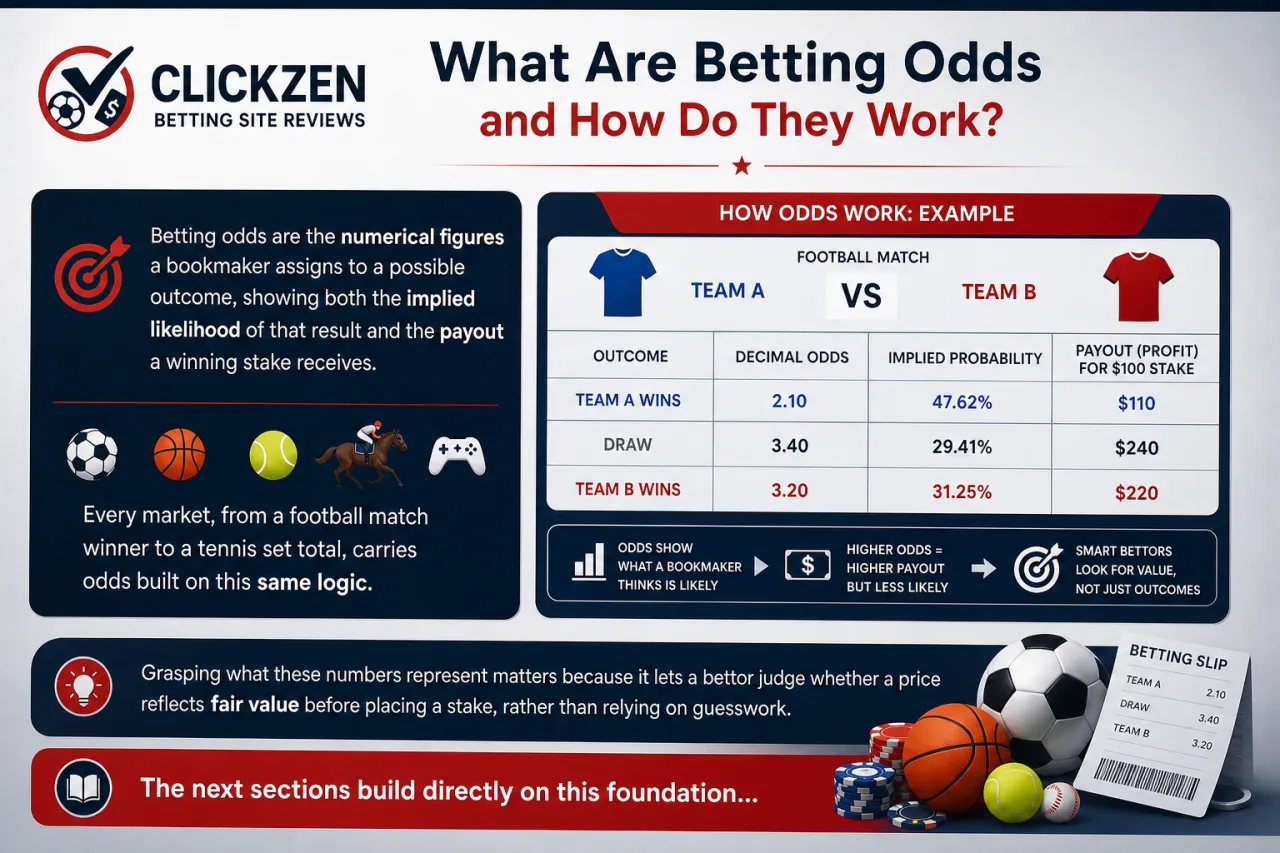
Betting odds are the numerical figures a bookmaker assigns to a possible outcome, showing both the implied likelihood of that result and the potential payout for a winning stake. Every market, from a football match winner to a tennis set total, uses odds based on this same fundamental logic.
Understanding what these numbers represent helps a bettor assess whether a price appears reasonable before placing a wager rather than relying only on intuition. The sections below explain fractional, decimal, and moneyline odds, how to convert between them, how implied probability is calculated, and how bookmaker margins influence the final prices offered.
Why Do Odds Matter for Every Bet You Place?
Odds matter for every bet because they determine the potential payout while also reflecting the bookmaker’s implied probability for an outcome. Misreading a price can therefore affect both the expected return and the assessment of risk behind a wager.
Three factors make odds important in practice:
- Payout depends on the odds offered, so misunderstanding a fractional, decimal, or moneyline figure can lead to an incorrect expectation of returns.
- Implied probability shows the likelihood represented by the quoted price, helping bettors compare that figure with their own assessment of an outcome.
- Risk and potential value can be evaluated by comparing the bettor’s estimated probability with the price available in the market.
Because probability and potential return are linked through the odds, understanding the quoted price is an essential part of evaluating any wager.
What Are the Different Formats of Betting Odds?
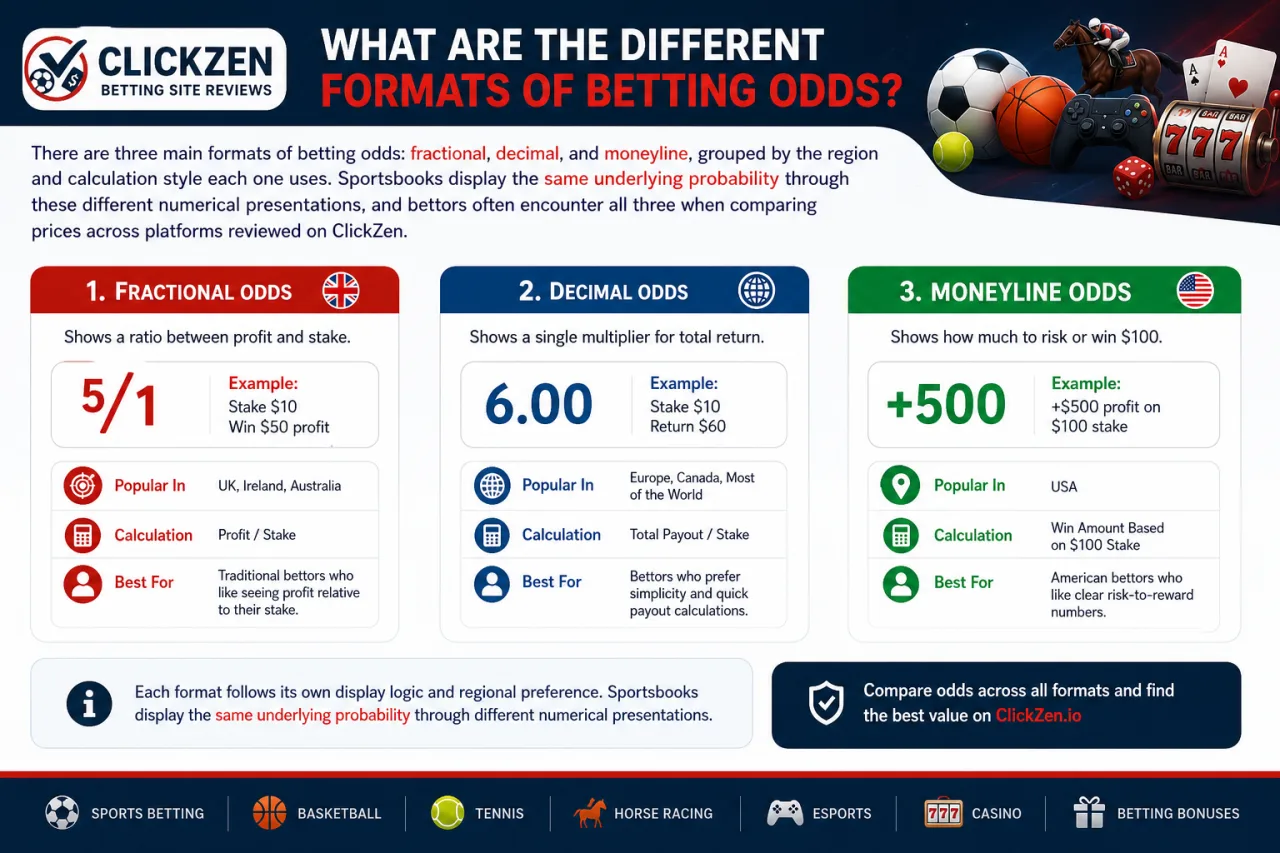
There are three main formats of betting odds: fractional, decimal, and moneyline. Each format represents the same underlying relationship between probability, stake, and potential return but presents the information differently.
Fractional odds display profit relative to stake, decimal odds show the total return as a multiplier, and moneyline odds use positive or negative figures based on a $100 reference amount.
The following sections explain how each format works and how to interpret common examples.
How Do Fractional Odds Work?
Fractional odds show potential profit relative to stake as a ratio, written as two numbers separated by a slash, such as 5/1. This format is particularly common at UK sportsbooks and in horse racing.
The fraction represents profit separately from the returned original stake.
- The numerator shows the potential profit.
- The denominator shows the amount that must be staked to earn that profit.
- Odds of 5/1 mean a $1 stake can produce $5 in profit, plus the original $1 stake, for a total return of $6.
- Odds of 1/5 mean a $5 stake can produce $1 in profit, plus the original $5 stake.
Fractional prices greater than even money, such as 5/1, are known as odds-against, while prices shorter than even money, such as 1/5, are known as odds-on. Odds-on selections are typically strong favorites, but the fraction itself primarily describes the price rather than serving as an absolute favorite-or-underdog classification.
How Do Decimal Odds Work?
Decimal odds show the total potential return as a single multiplier applied to the stake, such as 6.00. This format is widely used across Europe, Australia, Canada, and many international sportsbooks.
Unlike fractional odds, decimal odds already include the original stake in the displayed figure.
- Multiply the stake by the decimal odds to calculate the total potential return.
- A price of 6.00 on a $10 stake produces a total potential return of $60, consisting of $50 profit plus the original $10 stake.
- A price of 1.50 on a $10 stake produces a total potential return of $15, consisting of $5 profit plus the original stake.
Decimal odds of 2.00 represent even money and correspond to a 50% raw implied probability. Odds below 2.00 imply a probability above 50%, while odds above 2.00 imply a probability below 50%. In a market, the selection with the shorter odds is generally considered the favorite, but the 2.00 threshold alone should not be treated as an absolute favorite-or-underdog rule because bookmaker margins can cause more than one selection to be priced below 2.00.
How Do American (Moneyline) Odds Work?
American odds, also known as moneyline odds, use positive and negative numbers based on a $100 reference amount. They are most commonly used by US sportsbooks, although many international betting platforms also allow users to select this format.
- Positive moneyline odds show how much profit a $100 stake would generate. For example, +250 represents $250 of potential profit on a $100 stake.
- Negative moneyline odds show how much needs to be staked to generate $100 in profit. For example, -150 represents a $150 stake to potentially earn $100 in profit.
- Higher positive figures generally represent longer-priced outcomes, while larger negative figures represent shorter-priced outcomes.
A moneyline price of -110, commonly seen on point spreads and totals, requires a $110 stake to generate $100 in potential profit. Converting moneyline prices into decimal or fractional odds makes it easier to compare them directly with sportsbooks using other formats.
How to Convert Between Fractional, Decimal, and Moneyline Odds?

Fractional, decimal, and moneyline odds can be converted using standard mathematical formulas. Conversion is useful when comparing prices across bookmakers that use different display formats.
- Fractional to decimal: divide the numerator by the denominator, then add 1. For example, 5/1 becomes (5 ÷ 1) + 1 = 6.00.
- Decimal to fractional: subtract 1 from the decimal figure, then express the result as a simplified fraction. A decimal price of 6.00 becomes 5/1.
- Decimal to moneyline: for decimal odds of 2.00 or higher, subtract 1 and multiply by 100. For decimal odds below 2.00, divide -100 by the decimal figure minus 1.
- Moneyline to decimal: for positive moneyline odds, divide the figure by 100 and add 1. For negative moneyline odds, divide 100 by the absolute value of the figure and add 1.
| Fractional | Decimal | Moneyline |
|---|---|---|
| 5/1 | 6.00 | +500 |
| 1/1 | 2.00 | +100 |
| 1/5 | 1.20 | -500 |
| 4/5 | 1.80 | -125 |
The table shows that 5/1, 6.00, and +500 represent the same underlying price expressed in three different formats.
What Is the Formula to Convert Fractional Odds to Decimal?
To convert fractional odds to decimal, divide the numerator by the denominator and add 1. Adding 1 accounts for the original stake being included in the total return.
For example, converting 7/2 works as follows:
7 ÷ 2 = 3.5
3.5 + 1 = 4.50
A $10 stake at decimal odds of 4.50 therefore produces a total potential return of $45, consisting of $35 profit plus the original $10 stake.
- Divide the numerator by the denominator to calculate profit per unit staked.
- Add 1 to include the returned original stake.
- Use the resulting decimal figure as a direct multiplier for the stake.
The same formula applies to both long and short fractional prices.
What Is the Formula to Convert Decimal Odds to Moneyline?
Converting decimal odds to moneyline requires different formulas depending on whether the decimal price is at least 2.00 or below 2.00.
- Decimal odds of 2.00 or higher: (Decimal Odds – 1) × 100. For example, 4.50 becomes (4.50 – 1) × 100 = +350.
- Decimal odds below 2.00: -100 ÷ (Decimal Odds – 1). For example, 1.80 becomes -100 ÷ (1.80 – 1) = -125.
A decimal price of 4.50 and moneyline odds of +350 therefore represent the same potential return. Likewise, decimal odds of 1.80 are equivalent to moneyline odds of -125.
What Is the Formula to Convert Moneyline Odds to Fractional or Decimal?
Moneyline odds can first be converted into decimal odds and then, if required, converted from decimal into fractional form.
- Positive moneyline to decimal: divide the figure by 100 and add 1. +350 becomes (350 ÷ 100) + 1 = 4.50.
- Negative moneyline to decimal: divide 100 by the absolute value of the moneyline figure and add 1. -125 becomes (100 ÷ 125) + 1 = 1.80.
- Decimal to fractional: subtract 1 from the decimal figure and express the remainder as a simplified fraction.
A moneyline of +350 therefore equals decimal odds of 4.50 and fractional odds of 7/2. A moneyline of -125 equals decimal odds of 1.80 and fractional odds of 4/5.
How to Calculate Implied Probability and Potential Payouts from Odds?
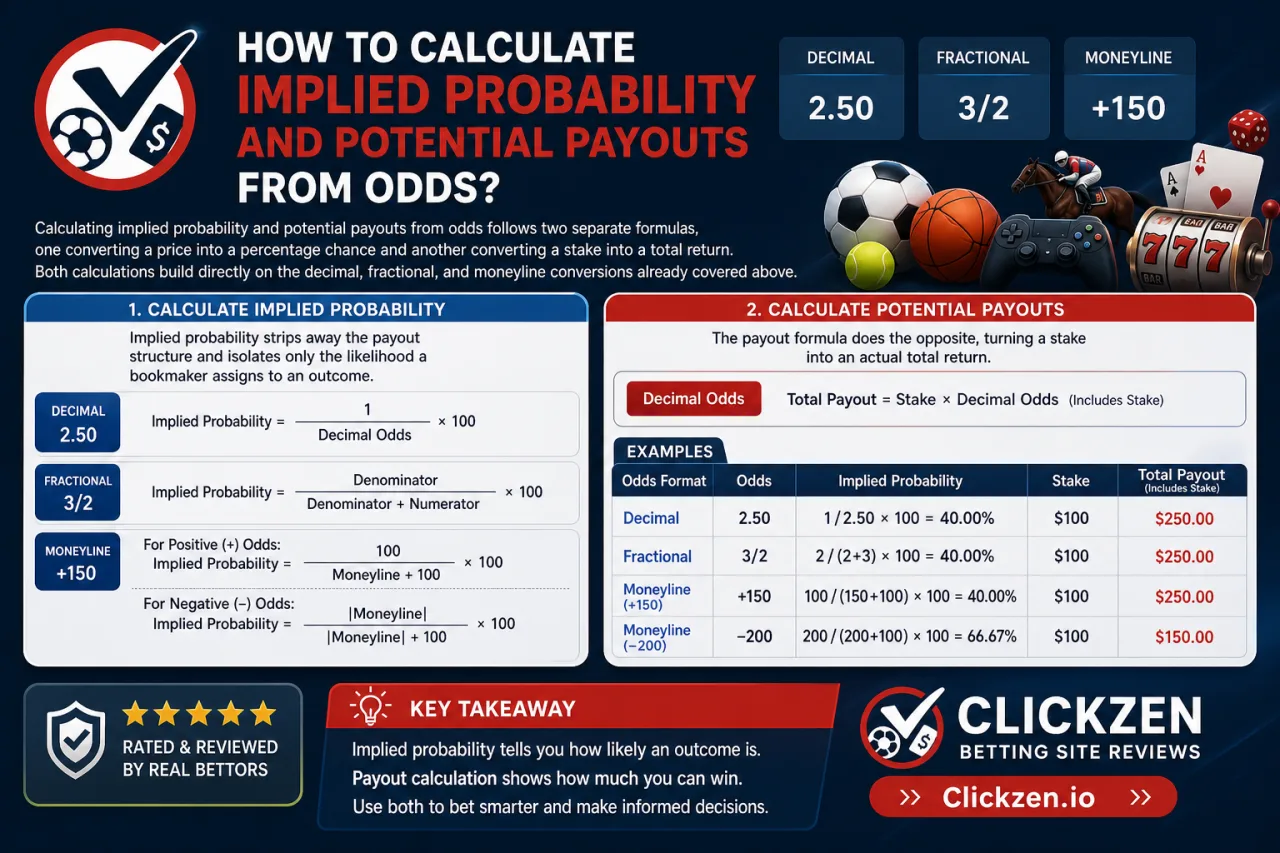
Implied probability converts betting odds into a percentage, while payout calculations show the potential return generated by a particular stake. Both calculations help bettors interpret a quoted price more clearly.
Implied probability represents the probability embedded in the quoted odds before removing the bookmaker’s margin. Potential payout, meanwhile, depends on the stake size and price offered.
How Do You Calculate Implied Probability from Decimal, Fractional, and Moneyline Odds?
Each odds format uses a specific formula to calculate implied probability.
- Decimal odds: (1 ÷ Decimal Odds) × 100. Decimal odds of 4.00 produce an implied probability of (1 ÷ 4.00) × 100 = 25%.
- Fractional odds: Denominator ÷ (Numerator + Denominator) × 100. Fractional odds of 3/1 produce (1 ÷ (3 + 1)) × 100 = 25%.
- Positive moneyline: 100 ÷ (Moneyline + 100) × 100. A price of +300 produces (100 ÷ 400) × 100 = 25%.
- Negative moneyline: Absolute Moneyline ÷ (Absolute Moneyline + 100) × 100. A price of -300 produces (300 ÷ 400) × 100 = 75%.
A decimal price of 4.00, fractional odds of 3/1, and moneyline odds of +300 therefore all represent a raw implied probability of 25%.
It is important to note that bookmaker odds normally include a margin. For this reason, the implied probabilities of all outcomes in a market can add up to more than 100%.
How Do You Calculate Your Potential Payout and Profit from a Bet?
For decimal odds, potential total payout is calculated by multiplying the stake by the decimal price, while potential profit is calculated by subtracting the original stake from that total.
- Total Payout = Stake × Decimal Odds
- Profit = Total Payout – Stake
| Stake | Decimal Odds | Total Payout | Profit |
|---|---|---|---|
| $10 | 4.50 | $45.00 | $35.00 |
| $25 | 4.50 | $112.50 | $87.50 |
| $50 | 1.80 | $90.00 | $40.00 |
| $100 | 1.80 | $180.00 | $80.00 |
For example, a $10 stake at decimal odds of 4.50 has a potential total payout of $45 and a potential profit of $35. Bettors using fractional or moneyline odds can either calculate returns directly using those formats or convert the price to decimal odds first.
How Do Bookmakers Set Odds and Build in a Margin?
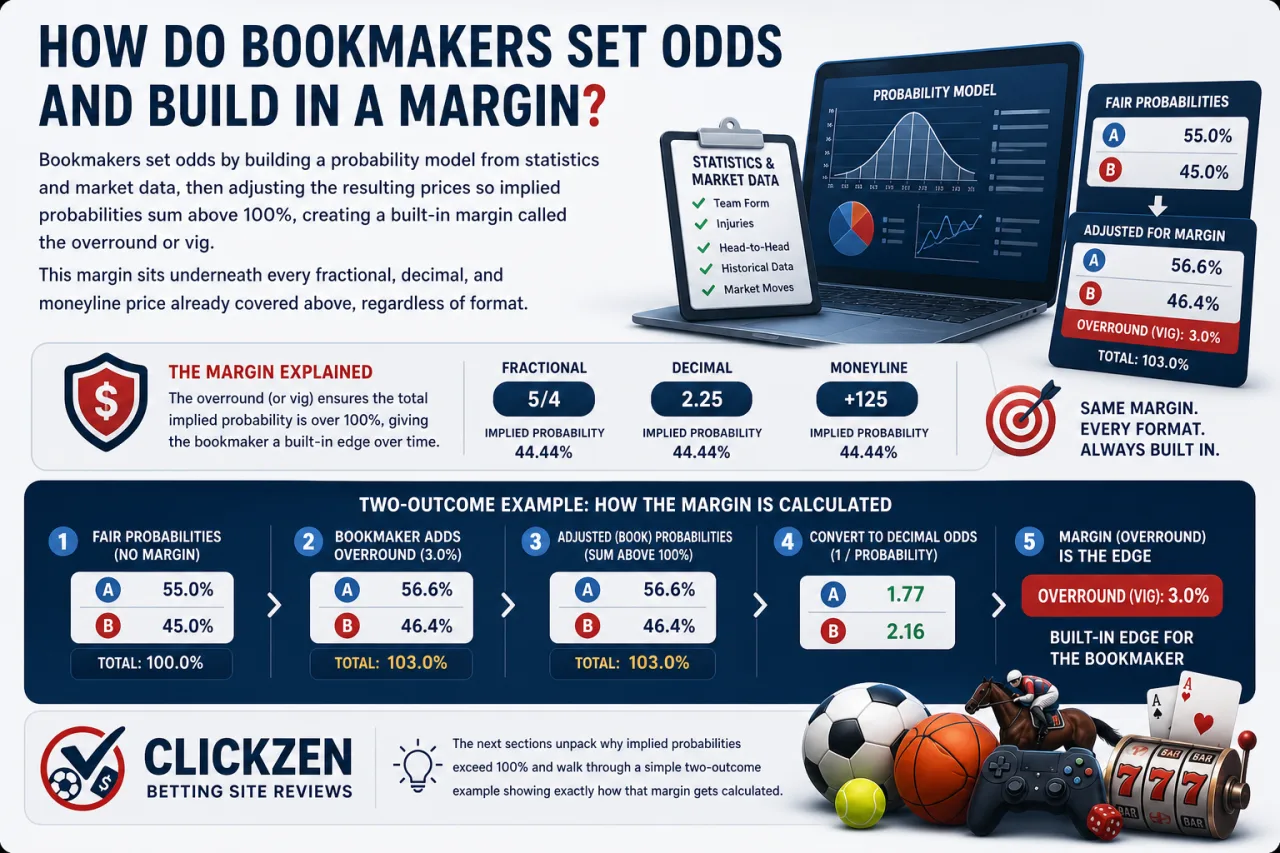
Bookmakers set odds using statistical models, historical data, market information, trader judgment, and betting activity, then adjust the resulting prices to include a margin. The combined implied probabilities of all available outcomes therefore usually exceed 100%.
This difference above 100% is commonly called the overround. It represents a theoretical pricing advantage for the bookmaker rather than a guaranteed profit from every individual market.
What Is Bookmaker Margin (Overround) and Why Does It Exist?
Bookmaker margin, commonly measured through the overround, is the additional probability built into a market when the implied probabilities of all outcomes total more than 100%.
The margin is incorporated into the quoted prices rather than appearing as a separate charge on a standard bet slip.
- Each outcome can be priced slightly shorter than its estimated fair odds.
- The combined implied probabilities therefore exceed the 100% associated with a margin-free market.
- The size of the overround can vary between bookmakers, sports, markets, and events.
The margin gives bookmakers a theoretical long-term pricing edge. Actual financial results on an individual market can still depend on factors such as how stakes are distributed across outcomes, changes in liability, and the final result.
How Can You Estimate a Bookmaker’s Margin from the Odds?
To estimate the overround, convert every outcome’s odds into implied probability, add those percentages together, and subtract 100%.
The calculation involves three steps:
- Convert each outcome into implied probability.
- Add all implied probabilities together.
- Subtract 100% from the combined figure.
For example, consider a two-outcome market where both selections are priced at decimal odds of 1.90.
Each selection has a raw implied probability of:
(1 ÷ 1.90) × 100 = 52.63%
The combined implied probability is:
52.63% + 52.63% = 105.26%
The overround is therefore:
105.26% – 100% = 5.26%
This means the market has an overround of approximately 5.26%. The figure measures the amount by which the combined implied probabilities exceed 100%; it should not be interpreted as a guarantee that the bookmaker will earn exactly 5.26% from the market.
What Other Factors Influence How Odds Move and Are Displayed?
Odds can change because bookmakers update probability estimates, react to new information, respond to betting activity, or manage financial exposure. The format in which those odds appear also varies by sportsbook and region.
Why Do Odds Change Before an Event Starts?
Odds can change before an event starts as new information enters the market and bookmakers update their prices.
- Significant betting activity on an outcome can contribute to price changes as bookmakers manage market exposure.
- Injury reports, team selections, suspensions, weather conditions, and other relevant news can alter probability estimates.
- Movement at competing sportsbooks or major betting exchanges can influence how bookmakers update their own markets.
- Risk-management decisions can also lead a sportsbook to adjust prices when liabilities become concentrated on particular outcomes.
A changing price can therefore reflect updated probability estimates, betting activity, new information, or risk-management decisions. However, shorter odds do not guarantee that an outcome will occur.
Do All Bookmakers and Regions Display Odds the Same Way?
No, sportsbooks and regions commonly use different odds formats, even though the underlying price can be mathematically equivalent.
- Fractional odds are strongly associated with UK sportsbooks and horse racing.
- Decimal odds are widely used across Europe, Australia, Canada, and many international betting markets.
- Moneyline odds are particularly common at US sportsbooks.
Many international platforms reviewed on ClickZen allow users to switch between decimal, fractional, and American odds in their settings. Changing the display format does not change the underlying price or potential return.
Conclusion
Fractional, decimal, and moneyline odds express the relationship between probability and potential return in different numerical formats. Understanding how to read and convert these prices makes it easier to compare betting markets across sportsbooks and regions.
Implied probability provides a way to interpret the likelihood represented by a quoted price, while payout calculations show how that price affects the potential return on a particular stake. Bookmaker odds also include a pricing margin, which causes the combined implied probabilities in a market to exceed 100%.
Odds can continue to move as new information, betting activity, and risk-management decisions affect the market. Reading these changes accurately can help bettors understand how a sportsbook is pricing an event, but no quoted price can guarantee the final outcome.
Marcus Zeno is a Betting Analyst and Review Editor at Clickzen.io with over eight years of experience in the online betting industry. He specializes in reviewing sports betting platforms and online casinos, analyzing odds, bonuses, and market trends. With a background in economics and finance, Marcus delivers objective, data-driven insights to help readers make informed and responsible betting decisions. Email: [email protected]


Top Rated Casinos

FanDuel is a regulated North American betting and gaming brand offering Sportsbook, Casino, Fantasy, Racing and prediction markets, with product availability determined by state or provincial regulations.

DraftKings is a regulated North American sportsbook and gaming operator offering sports betting, live wagering, casino games, daily fantasy sports, Pick6 and horse racing in eligible jurisdictions.

Fanatics Sportsbook is a regulated U.S. betting platform available in 23 states plus Washington, D.C., offering major sports markets, live betting, same game parlays and a distinctive FanCash rewards ecosystem.


ClickZen is an independent betting information and review website providing clear, practical insights into sportsbooks, online casinos, betting apps, bonuses, and related services for a global audience.
This website is intended for users aged 18 and over. Gambling can be addictive, so please gamble responsibly. The content on this website is for informational purposes only.
About ClickZen